Select Projects
These films showcase my approach to conveying the stories of untapped ideas, meaningful memory, rooted culture, and human stakes through real-world cinematic storytelling.
The work is relational, philosophical, and narrative at the same time. I look for human bonds and the thread that gives an audience the real reason they should care, and the sensory language that can make history, faith, beauty, challenges, and mission tangible.

-
There are few Christians left in Scandinavia.
That is how The Remnant starts. That is the core challenge and crisis at the heart of the film.
The Remnant was never made to promote a specific business or an organization. It grew organically out of a deep friendship with my friend and collaborator Mikkel, who invited me to spend a week at his farm to get to know his family and his growing community in rural Denmark, culminating in a harvest festival we put on for their friends and neighbors.
The questions driving the film were simple, but heavy: What does it look like to actually have an organic, deep-rooted community where people share a true story about where they come from, who they are, and what they can be? What does it look like when families decide to leave behind the atomization of their previous lives: lives without deeper spiritual meaning, lives without connection to something higher? That was Mikkel’s personal story, and it is the story of nearly everyone in that community as they have been drawn together around a shared purpose and a shared way of life.
In the process of filming, a core theme emerged: a real tension between two vital needs. On one side, the need for a culture to develop and connect to grand narratives, to deep mythological and spiritual purpose, and to a sense of place and destiny in history. On the other side, the need for deep individual embodiment: personal thought, individual conviction, and a direct, uncompromising life lived in faith before God.
To convey both modern Denmark and the significance of what these families are doing, from scattered, isolated individuals into something broader, I wove a larger historical and metaphysical thread directly into the edit. That thread is embodied in two titans of 19th-century culture and thought, both born in the exact same year: Søren Kierkegaard and Richard Wagner.
Even today, their names evoke polarizing reactions. Wagner placed massive emphasis on the creation of collective, grand mythopoetic and spiritual narratives. Kierkegaard placed extreme emphasis on the individual's direct connection to God, driving a wedge and shining a harsh light on the complacency and cultural softness of a Christendom where faith was merely the conventional norm and demanded very little of individual conviction.
In modern Denmark and across broader Europe, many people still have not fully reckoned with Kierkegaard, and many have not reckoned with Wagner. What look like contradictory worldviews are actually two interrelated wounds: two missing gaps in the essential breath that animates life and culture today. You cannot have the collective grand narrative without the personal spiritual conviction. It is the same dialectic later embodied by J.R.R. Tolkien in his quest for a grand mythological narrative for the English people, and C.S. Lewis in his profound writings on personal Christian faith. They are two sides of the same element, meant to be brought together in friendship and union.
Visually, I chose to shoot in anamorphic on vintage-style lenses to place great emphasis on natural light and the organic, tactile experience of the people. I wanted an intimate glimpse into the homes, the craftsmanship, and the subtle touches of Scandinavian life: the Dala horses on the shelves, the paint palettes, the literature, and the quiet daily rhythms of the families.
So many of the best moments were entirely unplanned. That is both the challenge and the beauty of documentary craft. You plan as much as you can in pre-production: you structure the questions, the shoots, the locations, the themes, and the overarching vision. But when you are meeting with real, living, ordinary people in a dynamic environment, the whole world becomes your set. That is when the unexpected moments emerge: moments of humor, insight, pain, tension, joy, and solace.
The real craft came in the final edit: leaning into sound design, patient pacing, and structuring the conversations so they flowed organically, leaving room for unresolved tension. We allowed the intimate story of one Danish farm to sit naturally inside the deep history of Scandinavia, where the larger currents of civilization, culture, and faith are still quietly moving

-
The Gift of Life Transplant House had a compelling story in the heart of the Midwest that was vital to share, but it lived in scattered articles, VHS tapes starting to decay in local television station archives, paper books, and the personal photo albums on the shelves of extended relatives of the founder. The founder, Ed, had recently passed away, so we did not have the opportunity to interview him directly.
How do you take a story that spans over forty years, deeply tied to the life of one man and the community that grew around him, and convey a compelling narrative when he is no longer there to speak? How do you take an institutional history trapped in paper records and old tapes and make it tactile on screen?
My approach was to immerse myself completely in the legacy before rolling a camera. Like an archivist poring through old records, I started with the literature: the book Ed wrote about his life and the creation of the house, and the book his mother wrote detailing his childhood medical journey and upbringing. I needed to understand his mindset from the inside out.
From there, I turned to the living community. Ed's family still lived largely in the region, and several original founding board members and volunteers were still nearby. I organized a series of seven interviews to capture first-hand testimonies of the man behind the work. Alongside those conversations, we dug deep into the physical archives. We uncovered compelling photographs, created high-resolution scans, tracked down decaying broadcast footage that would have been permanently lost if we had not rescued it, and shot deliberate, tactile B-roll around the physical albums themselves.
The narrative hook came from weaving several distinct threads together. Each decade from 1984 onward carried its own visual texture and character, from early home video to contemporary cinema, and the long-running stories of transplant patients and caregivers coming to the Mayo Clinic carried through that progression. The stakes were deeply personal. Ed had walked that exact path of severe illness as a child and endured extreme health challenges his entire life. Yet his focus remained relentlessly outward. The core of the film became one man's love for his community: turning and redeeming his suffering into something incredible for other people.
As I studied his writings and spent time with his words, another foundational element became impossible to ignore: how profound and serious his faith in God was. It was Ed's faith that defined who he was, giving him the capacity to shoulder heavy suffering while remaining genuinely joyful and focused on the people around him.
We wove that spiritual core together with the story of the house, the fragile early years when the organization could have fallen apart, and the legacy of his family. His children grew up inside this outward-facing mission and remain involved today. Now his grandchildren are growing up within the rituals and organic culture that took root around the house. By grounding the history in real lives, the film moves from archival discovery to moments of what daily life looks like in the house today, showing families actively being supported through their hardest moments.
The primary artifact was a documentary cut produced for the big screen. We hosted a large cinema screening and fundraiser, executing the project to a standard worthy of a theater: putting disciplined craft into the cinematography, audio mix, motion graphics, and sound design to ensure it felt lasting.
In the time since its release, the film has delivered two distinct functions for the organization. Internally, it has become an invaluable onboarding resource for new staff who never had the chance to meet Ed. In under an hour they can grasp the mission, see the rich history, understand the faith and conviction that started it, and build a real connection to the founder. Externally, I produced a shorter cut that captures the core essence of the documentary, which now lives directly on the organization's homepage, giving incoming patients, donors, and families an immediate human bond with the work.
-
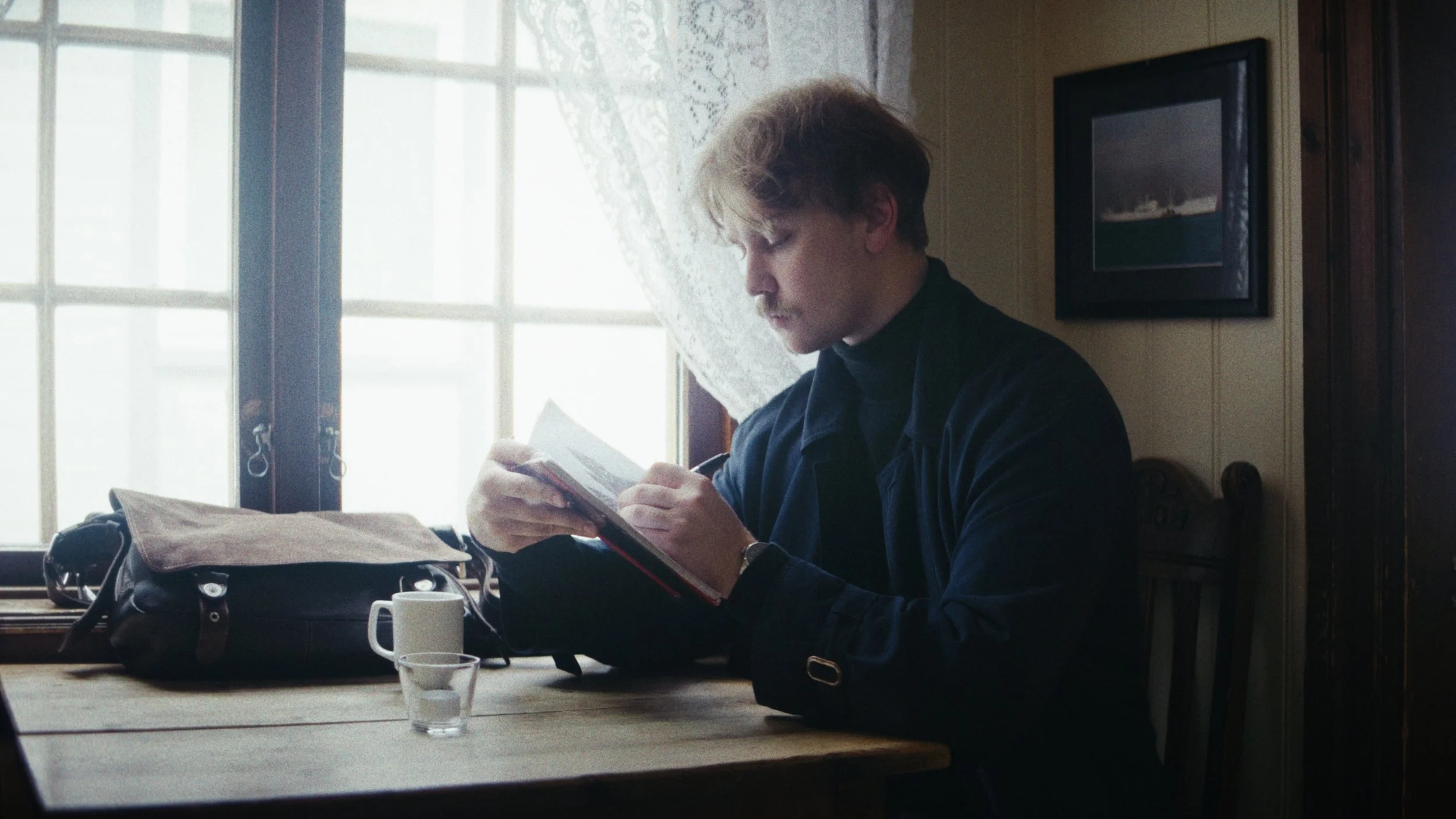
Embers is a short independent documentary from Trondheim, Norway, tracing one student's search for ancestral memory, spiritual weight, and a living connection to the transcendent in a secular age.
They say constraints breed creativity, and after two years focusing on ambitious long-form documentaries from icy fjords to midwestern farms, I took the opportunity this summer to challenge myself to keep a project far more narrow and restrained in scope and run-time. Focused around a profile of one student and his experience and questions, Embers became a way to explore the questions at the heart of Norway through another’s eyes.
Filmed on a set of manual-focus Blazar Viper anamorphic lenses, I spent a week in the heart of Norway to explore the Gen-Z experience across Trondheim’s ancient cobblestone streets, cozy cafes, and late-night drinking parties.
It was clear that local student Håvard M. Poquet had identified something amiss with culture, something not expressed properly. Unable to experience true Dasein in the broader culture, Håvard shared with me how he is turning to Snorri Sturluson, J.R.R. Tolkien, and Knut Hamsun. In conversation, he expressed the painful loss of ancestral memory.
Disillusioned by pop-culture caricatures of "biker barbarians," he turned to ancient Norse sagas, western literature, and the weight and presence of sites like Nidaros Cathedral, searching for a living connection to the transcendent in an unapologetically secular age.
Walking past the towering medieval weight of Nidaros Cathedral in Trondheim with runes of pilgrims from ages past etched into its stones, we realize that modern Scandinavians traded something away.
This short documentary is an exploration of our modern relationship to ancestry, cultural amnesia, and the persistent spiritual longing (Sehnsucht) that modern secularism has failed to fully extinguish.
Embers carries the same underlying sensibility and media philosophy as the other projects: beauty treated seriously and seemingly ordinary moments of life given their true significance through the language of cinema. The piece centers fire, craft, atmosphere, stillness, and human attention, showing how a smaller film can still open onto history, culture, and the spiritual hunger beneath modern life and resonate powerfully with an engaged and highly targeted audience.
Every Frame with Intent
We invite viewers into spaces where thought and emotion coexist.